Hello, friends.
As we all know, reading is a glorious form of escapism. You disappear into worlds full of adventure and magic, and you meet people who bring those things to life and make you believe it’s all true. But the thing about believing those characters is that it only works if the characters themselves are believable. An author has not only the power but the obligation to breathe life into their characters, to make them relatable and realistic. To do so requires flaws, quirks, defined traits, backstories, etc.
In addition to that, every character must be different. Each person in your story needs their own unique identity that distinguished them from other characters. Otherwise, you end up with a bunch of carbon copies that are personality clones with different faces. If your dialogue can be easily given to any character or interchanged between them without it seeming like a breach of someone’s character, either get some better dialogue or, more likely, get some better characters.
These are some tricks to developing better characters.
Outline, outline, outline.
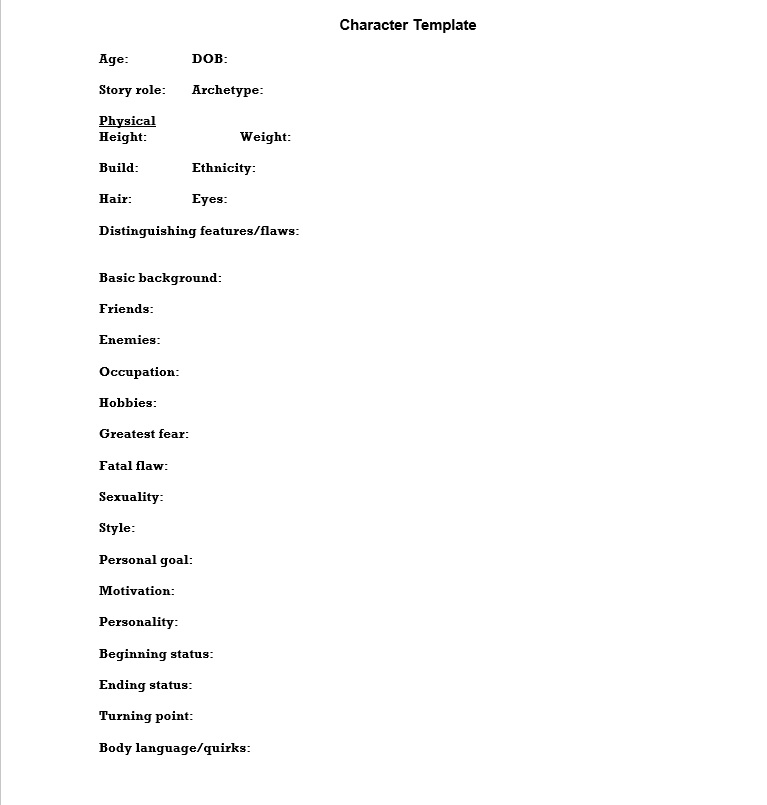
I can’t stress it enough. Outlining characters is essential for creating unique and varying personalities. I like to use a template (see photo) that includes physical descriptions, backgrounds, fears and motivations, and personality adjectives. That way, when I’m writing and I can’t figure out how a character might react, I can check the outline for a clue. A backstory can influence a character’s tiniest decisions. An adjective in their personality can decide the diction and tone they’ll use to react to an event. Fears can prohibit them from taking action in a severe situation and goals can propel them to do so. If outlining is something that slows down your inspiration, do it after the first draft and use your outlines for editing and rewrites. Go into writing with a clear idea of who you’re talking through and the rest of the story will follow.
Explore numerous personalities and traits.
As I said, it’s imperative that your characters are distinct from each other. Everyone has something that makes them a little different from everyone else. While fears and goals are obvious points of differentiation, it’s often the dialogue that makes the most impact in the feel of different characters. As much as everyone loves a sarcastic one-liner, not every character should possess the gift of delivering them. Even in stories where every character has a trait in common, they each have something to define their words as theirs. For instance, in Cassandra Clare’s The Mortal Instruments series, the characters are all fairly quippy in their dialogue. Still, each one has a way of maintaining their own identities: Simon has his nerdisms, Jace has his false bravado and arrogance, Clary has fiesty stubbornness. Explore varying traits in your characters and find ones that define their outward expression. Stories need variety to create conflict.
Research how different personalities interact.
When all else fails, you have two dependable sources for research: fiction and reality. Stephen King once said, “If you want to be a writer, you must do two things above all others: read a lot and write a lot.” Reading is where the soul of writing comes from. We learn by example, seeing what others do and deciding “I want to do that” or “I don’t ever want to see that in my work”. When stumped on how to find and define different personalities, look to a work of fiction and pay attention to what the characters are doing and how they’re interacting. Even looking to your own life can enlighten you as to how people are different from each other and how they coexist.
Leave room for change–and embrace it.
Remember, one of the most important aspects of developing characters is actually letting them develop. Characters undergo their journeys to learn something new, about the world and about themselves. Because of what they learn, they grow. Their personalities probably remain fairly consistent (when was the last time your personality changed drastically because you learned a lesson?) but their fears and motivations do not. When characters learn and grow, the way you present them must do the same.
Pay attention to what your characters are doing.
We’ve all been there. That “well how did this happen?” moment in a story. Sometimes characters create an unanticipated turn and you’re left dumbfounded as to how it happened. While this can be a great source of inspiration, almost like the story is writing itself, you must keep an eye out to make sure your characters aren’t doing anything too wild. Characters have power over the story but authors have power over the characters. It’s your job to keep them in line and to ensure they’re staying true to themselves. If they’re doing something new and unexpected, it should make sense in how the story and how they as a character are developing.
These are only a few of the ways to develop a character. Do you have any additional methods for developing characters? When was a time your character did something unexpected and you had to reel them in to get them on track? Let me know in the comments, and if you have any other requests or suggestions, leave them there as well. Feel free to like and follow me for more writing tips. Thanks for reading!
Great fiction is fueled by bad decisions and human weakness.
— Kristen Lamb
 Jayda Louise